FREE sourcing support, up to 3%. Eligibility applies to qualified business buyers and is confirmed after we review your product, quantity, destination, and sourcing requirements.
Specification Center ยท loads
Independent sourcing service. This page is not portakabin and is not affiliated with portakabin. GridField Sourcing compares alternative products against the loads you supply. It does not claim manufacturer status or authorized dealer status, and it does not offer the named brand as its own supply.
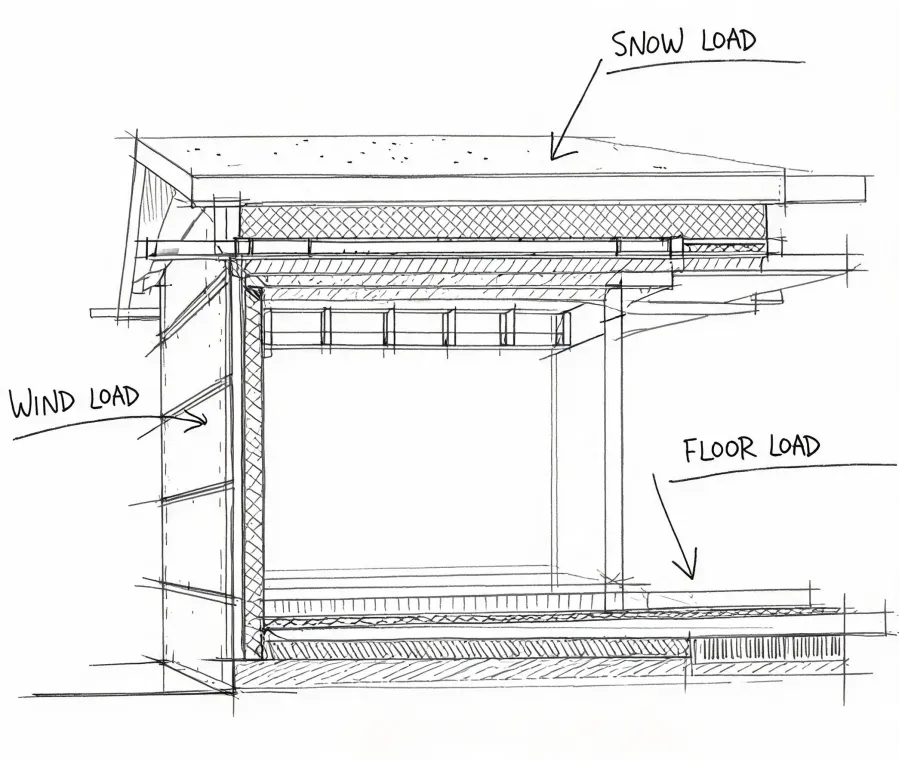
This page is a worksheet for design criteria. It is not an environmental pledge and it is not a certificate wall. Wind speed, ground snow load, seismic design category and floor loads are recorded so two quotations refer to the same structure, not the same brochure.
Project address or coordinates, exposure, and the authority having jurisdiction. Without a place, a wind speed is a guess.
Design dead load of the envelope and design live load of the floor, plus collateral such as ceilings or solar if the buyer requires them.
Wind speed, wind exposure category, ground snow load and seismic design category, each tagged with its source.
Module dimensions or clear span, eave height and bay spacing. Geometry changes the member, even when the load number stays put.
The supplier names the code edition and the calculation that used these inputs. The buyer checks that the file matches the quoted system.
| Gravity and use | |
|---|---|
| Design live load | Buyer states the occupancy. A site office, a classroom and a storage bay are not the same floor. |
| Design dead load | Include the envelope the supplier is actually offering, not a generic roof slogan. |
| Collateral | Ceilings, sprinklers, photovoltaics or a unit heater, if required, are separate lines. |
| Environmental criteria | |
| Wind speed | Record the speed and the wind exposure category the jurisdiction uses. Do not copy a national map without the site. |
| Ground snow load | State the ground value and whether the supplier will convert it for the roof geometry. |
| Seismic design category | Use the category for the site. Leave it blank if the geotechnical or code data is not in hand. |
| Frame and skin | |
| Primary frame | Rigid frame, cold-formed steel or a volumetric chassis. The quote must say which. |
| Secondary framing | Purlin and girt spacing if the system uses them. Panelized walls may describe studs instead. |
| Envelope performance | Thermal transmittance or R-value, and any fire-resistance rating the jurisdiction requires, as supplier statements. |
| Documents | |
| Load path | Reactions at the foundation interface, and who designs the pad. |
| Standards to request | ASCE 7 for loads, AISC 360 for steel design, AWS D1.1 for weld documentation when steel is in the quote. These are requests. |
Volumetric modular construction carries more completed work inside the transport envelope, so lifting and road limits sit beside the load cases. Panelized construction can reduce the shipping cube and increase the site work that must be watched for weather. A standardized module is easier to compare when the published size fits. A custom span is the right question when clear span or eave height does not. Shell scope leaves foundation and set with the buyer. Turnkey scope still needs exclusions written out. Price lines from those two scopes are not one market.
IBC, IRC and HUD Code are different approval paths. A modular commercial building, a house and a HUD Code home should not share one unchecked compliance sentence. GridField Sourcing will not state that a quotation meets a US code. The supplier document and the authority having jurisdiction do that work.
Any load the buyer has not sourced, any envelope rating not yet required in writing, and any choice between volumetric and panelized that depends on a road or a crane the team has not measured. Open lines are listed. They are not filled with a typical value from another project.
That the calculation uses the buyer criteria, that the geometry matches the module dimensions or frame on the quote, that the foundation reactions are present, and that exclusions for transport, set and utilities are still the ones the buyer thinks they bought.
No. A published system may show an example wind or snow case. The example is not the project. Ask the bidder to rerun or to mark the example as not applicable.
Optional USD budget and a premium, mid-range, budget-friendly or undecided supplier preference are buyer notes. They do not change the load cases and they are not a verified ranking of factories.
GridField Sourcing will attach that text to the supplier questions. It will not invent a load to make a quote look complete.